Tuesday, September 4, 2007

Gretta, modeling FrankenDresses


This is an update for the FrankenDress post, because my fashion model was unavailable when it was written.

Monday, September 3, 2007

My Monster in the Mirror

Are you familiar with the Sesame Street song, "Monster in the Mirror" sung by the Grover (the hapless blue monster who speaks without contractions)?

In the real lyrics by Norman Stiles, Grover sings, "Wubba wubba wubba, wubba wubba wooo".

Here is a link to a video of Grover the Monster performing it.

It's a very cute song as written, but during the Jewish New Year season I always think of it with the following slightly modified lyrics: (Note: "mochel" is the Hebrew word for "forgive". We formally ask each other for forgiveness around this time of year.)


Grover: Saw a monster in my mirror when I woke today. A monster in my mirror, but I did not run away.I had to face my fear and look inside my head. Though the monster looked at me and this is what he said:

Chorus: He asked, "Won't you, mochel, mochel, mochel, mochel me?
Mochel, mochel, mochel, won't you mochel me please?"


He asked, "Mochel, mochel, mochel" so I asked him too: "Will you mochel me, and I will mochel you."

Monsters: Will you mochel me? Please know I mochel you.

Grover: Told the monster in the mirror, "I am kind of scared." Nervously smiled at him because he saw my soul was bared. Well, the monster wondered what to do, he smiled right back and then... The monster in the mirror sang this song again:

Chorus: He went "Won't you, mochel, mochel" and I sang along, cause "Mochel, mochel, mochel" is a proper song.

Monsters:
"Mochel, mochel, mochel" is a proper song.

Grover and monsters: Chorus (a capella/voices only)

Grover: He went, "Won't you, mochel, mochel" and I sang along, (instrumental music returns) 'Cause "Mochel, mochel, mochel" is a Tishrei song.

Monsters: "Mochel, mochel, mochel" is a Tishrei song.

Grover: Every mirror has a monster in it, do not doubt. This kind of situation does not call for freaking out. And do nothing that you would not like to see him do...'Cause that monster in the mirror, he just might be you!

Chorus:
"Mochel, mochel, mochel", you can join in too. Please will you mochel me? And know I mochel you."

Monsters: Will you mochel me and I will mochel you?

Grover:
In Tishrei, "Will you mochel me?" is the thing to do.

Grover and monsters: Yes, please mochel us. We mochel you.

Unidentified monster: (spoken) We mochel you.

T minus 10 and counting... Do you know where your pomegranates are? (jGTD)

That's T for the Hebrew month of Tishrei. And 10, as in 10 days.

Rosh Hashanah starts on the first day of Tishrei. This year (2007, or 5768, depending on which calendar you're using) it begins on Wednesday evening, September 12. Counting TODAY, there are 10 days left until Rosh Hashanah.

What follows is my own non-exhaustive, imperfectly-edited collection of lists of things to freak out about consider before the Jewish ("high") holidays. I'm sharing them because it can be helpful to read such a list (not to adopt it completely, but rather) as a trigger to remember things that might otherwise fall through the cracks.

The list items are in no particular order.

If you don't find this type of exercise helpful, please move along. This is a ridiculously long post.

Spiritual preparation is not in the scope of this message. The purpose of these lists is to focus on the physical stuff to clear our heads for the Big Stuff to come.

I guess you could call this an exercise in Getting Jewish Things Done (jGTD? gJtd?)

(Disclaimers: Since this is my list, it is geared to our Ashkenazi, non-chassidic, yekkish (German-Jewish), orthodox family living outside-of-Israel (in the U.S.) Everyone's list will vary with their circumstances and customs.

We're hosts, not guests. If you're traveling, there will be scads of other stuff to do, such as acquiring hostess gifts, packing, etc. Personally, I'd rather cook for a month than pack for a week.

Please consult your local halachic authority about anything that differs from what you normally do. I'm not any sort of halachic authority. I don't even play one on t.v.

I'm not trying to tell anyone (other than my recalcitrant self) what to do. My goal is to help those who want to do these things remember that the time to do them is nigh.

Non-Jews are hereby invited to skip this post. Or you can stay and just smile and nod sympathetically like we do in December. Really, though, I can't imagine it holds any interest to those who aren't in this particular foxhole. Due to time constraints, I'm not going to translate the Jewish and Hebrew terms much. The
OU.org website is a fount of legitimate and useful information, such as their Jewish Holiday Calendar overview.

I'm sure I've forgotten at least something vital. Please don't immerse this list in water or hold it while running with scissors. I'm cold, go put on a sweater...
)

Preparing for Rosh Hashanah


Scheduling notes for Rosh Hashanah


Starts Wednesday, September 12, 2007 before sunset, officially ends on Friday night, September 14, but since that coincides with Shabbat, it effectively ends Saturday night, September 15.

We affectionately (yet inaccurately) call this phenomenon (when a two-day holiday gets extended due to its sharing a time border with Shabbat) a "Three Day Chag".

Rosh Hashanah is two days long, even for those who live in Israel.

With the exception of Rosh Hashanah, those who live in Israel celebrate only the first day of the double-day holidays. Thus, they are unaccustomed to the "Three Day Chag" situation, as it only comes up for them when Rosh Hashanah falls on a Wednesday night, as it does this year.

Those of us who live outside Israel experience this more often.

Things to do before Rosh Hashanah

  • Start a list of questions to ask the Rabbi, even if you don't have any yet. Try to ask questions early, as his schedule includes all that we have to do, along with a dozen high-pressure, high-profile public presentations and a gazillion other details.

    If for whatever reason the questions don't get answered (or asked) before/during this Tishrei (for example, due to discovering a workaround that avoids having to ask), if they are written down, you can ask them next month, in preparation for 5769.

    If they're not written down, they'll fall victim to post-chag amnesia.


  • Slichot!! Find the Slichot machzorim, put the date (depending on your minhag) on calendar. We have them this coming Saturday night, September 8, 2007.

    Find out the time - is it midnight? 11:pm? 1:am? I don't know why, but every year we forget this.


  • Verify that there is a box of matzah for the three eruv tavshilins that are required this month. (I have a box still leftover from Pesach this year. Mustn't allow anyone near it.)


  • Get the holiday schedule, including the shul's davening times entered on the family's calendar.

    Make sure the shul schedule is available in hard-copy somewhere public. Ours is in the reference binder on our refrigerator. Enter the candle lighting times onto calendar - especially if you use an electronic one.


  • Prepare an Eruv Tavshilin on Wednesday, September 12, 2007 during the day.


  • We won't have many weekdays this month, so it is helpful to pre-pay bills as much as possible, so they won't pile up.


  • Look into chessed opportunities particular to the season - blowing shofar for hospital patients, inviting overlooked local residents (especially singles and those new to the area), delivering Yom Tov food, etc. Schedule these now before the quicksand of the schedule buries the opportunities.


  • Buy honey for baking and for serving. We dip the bread in honey for every Yom Tov meal from Rosh Hashana through Shemini Atzeret.

    This is a huge concession on the part of my husband, who considers honey a Class 3 Controlled Substance. He hates the mess. Even outside in the Sukkah.

    Note: This video was made by someone else, who has a better sense of humor than my husband when it comes to honey.


    A family tradition has developed around this, where the kids goad him on about it, with exaggerated reveling in this custom as though it were halacha. It is very effective: their eyes dance and my husband's jaw sets at the mere mention of honey.


  • Buy or cut flowers for the table.


  • Get an article of new clothing or jewelry.


  • Check that everyone has enough outfits and undergarments including new or at least run-free stockings!) that fit for three days of synagogue and company meals.

    Remember that the kids probably grew over the Summer. Inspect these clothes for missing buttons, stains, etc. Set them aside to minimize the day-of-chag screams of "Hey! That was MY skirt. Who told you you could wear it today? ......EEEEEEma!"


  • Dry cleaning submitted and picked up. Do you know where your (husband's) kittel is?


  • Obtain whatever Simanim your family uses.


  • Obtain "New Fruit" (something you haven't eaten yet this year, to justify saying shehechiyanu on the second day)


  • Medication/vitamins for the month (consulting your local halachic authority as necessary if there is a need to take the on Yom Tov.)


  • Buy tons of eggs. Everything, including the eruv tavshilin will use eggs. Can always make egg salad or serve them hard boiled. Eggs last a while.


  • Establish a set place for the onslaught of tzedakah mail that comes with this season. Either make special folder in your inbox for it, or, if you use a tickler file, pick a date to make decisions and write checks.


  • Schedule cemetery visits.


  • Locate the machzorim (specialized holiday prayer books). Do they need covers? (Helpful when saving/finding seats in a roomful of identical books, and for their likely return if they get left behind.)

    Does the family need any new ones for kids who are newly old enough to read from them?

    I like to prepare my machzor with a few tissues tucked into the cover, and with a cloth napkin (because we bow to the floor, but not on a bare floor) for Yom Kippur.


  • List of family members and friends to call and wish good new year/yom tov.


  • Wednesday: Turn of alarm clocks!


  • Check if we need any new dishes/serving platters. Set aside things to tovel (immerse in the dishes mikvah before first use) and some time to do that. (No, driving around with the vegetable peelers in the minivan for three weeks doesn't obviate the need to actually dunk them. )

    Also, might be able to think of a substitute/friend to borrow from/etc. if you realize it now and don't want to purchase or don't have the resources (energy, time, money, decision making skills....) to buy.


  • Especially for mothers: try to schedule some time alone for Rosh Hashanah/Yom Kippur-type thoughts, in the midst of all the hectic planning


  • Acquire hostess gifts. Stockpile a few extra bottles of wine and a few pareve treats (not nuts, just in case someone has the minhag/custom to avoid them on Rosh Hashana) just in case.


  • Get haircuts


  • List menus, even if only a blank template that says "Wine - Simanim - Bread - Beverages - Fish Plates - Soup - Main course + 2 sides - Dessert - Coffee/Tea" for each of the meals of the holiday. I use pre-printed mailing labels for this. (Not likely to have this downloadable for 5768, but I'll try for next year to have them here.)


  • Make a list of guests to invite. Invite them.


  • Make the guest beds (even if not expecting any - you never know who will have to stay over, and a made bed doesn't have an expiration date) and check the overnight guest accommodations (clean towels, etc.)


  • Check supply of/iron/purchase/prepare table linens.


  • Start a shopping list


  • Prepare any blog posts, e-mail messages or voice mail announcements to warn people you'll be unavailable for certain dates.


  • Purchase seat reservations at shul.


  • Start a bag for things to bring and (if allowed) keep at shul. For the children: diapers, toys, sweets. Will still need to add snacks for the kids on the day of...


  • Make provisions for kaparrot. Although in English that word contains 'parrot', we don't use birds at all just $.


  • Pack a stroller bag. (Uh oh! I just realized: we need a new stroller! The wheel housing broke a few weeks ago. Oy.)


  • Arrange/pay for babysitting for Rosh Hashanah and Yom Kippur.


  • Any children's art projects made from now until Sukkot should be evaluated as potential Sukkah decorations. If there is a young child who doesn't attend school, make sure that child has a few pictures hung in the sukkah, so she/he won't be left out when everyone points out what they made.

    If necessary, anything can be 'laminated' by being slipped in a page protector. There should be something hanging in the sukkah from every child.


  • Make a plan for tidying up (at least the public rooms) that doesn't require doing much on erev chag.


  • Print some extra labels for food that is likely to be prepared during the chaggim. (Consult rabbi if this is okay and how to do it.)


  • This is a good time to have an empty inbox. That may not be realistic, but any extra moments spent toward this goal will be appreciated.


  • Clean out refrigerator and freezer to make space for Yom tov cooking. Cook as much as possible before the date in advance.


  • We don't use bread for tashlich, but if you do, you might want to set some aside.


  • Can't hurt to have extra apples and honey and pomegranates, etc. to serve as emergency hostess gifts. Can always use them in salads if not needed.

  • It's not a minhag, but we like to serve the 7 kinds at the Rosh Hashana table.
    Need to acquire these. (Note to self: put barley on the shopping list.)

    For a quick and tasty barley dish, prepare with a jar of spicy salsa. (Note to self: put a jar of salsa on the shopping list.)


  • Start baking round challot.


  • We don't send cards, but appreciate those we receive. We display them on a shelf until sukkot, when they'll morph into sukkah decorations. Still helpful to have a few cards on hand, in case need to reciprocate with someone who would be put off by not receiving a card.


  • Candles: Regular candles. In four weeks, have 10 candle lightings. Also check the stock of yartzheit candles both for transferring flame and for yizkor if necessary. (Thank G-d, we don't need them for this.) Have I mentioned there will be three 3-day chaggim chutz l'aretz?


  • Think about the status of the sukka from last year. Is anything broken? Can it be ordered? Need new scach?


  • Wednesday afternoon: Set cellphones, Blackberries, Palm pdas, and cordless phones up to charge, otherwise their power will drain over the next 3-4 days.


  • Wednesday afternoon: Run the garbage disposals before candle lighting time, so the sink drains will be empty and clear.


  • Polish silver (If you're into that sort of thing. Around here, we're fans of tarnish, calling it "patina".)


  • Wednesday (sometime): Empty the answering machine/voice mail so it won't overflow over the break.


  • Move the laundry to the dryer, leaving nothing in the washer to mildew over the break.


  • Try to have at least one dish to prepare with the kids, so they have sweet holiday preparation memories and no false advertising about the level of preparation required to make a holiday work.


  • Buy non-perishables NOW if haven't done so already. Also not a bad idea to have some emergency cake mixes, salad dressings, jarred sauces, etc. just in case homemade isn't possible.


  • Stock the refrigerator and freezer with ingredients as much as possible. Try to do a bit each day.


  • If you "do" GTD, try to get a weekly review done before Rosh Hashanah, but don't expect to do another until October. Brace yourself for October's to be a doozy.


Preparing for Yom Kippur


Scheduling notes for Yom Kippur


Starts Friday, September 21, 2007 before sunset, ends Saturday night, September 22. It's a special one this year, because it falls on Shabbat, although that has little impact on the preparations for it.

Things to do before Yom Kippur


  • Seuda Hamafseket - the meal before the fast. Write in bold the time it should end. Think about the menu. We do a carbo-loading menu for this, just like the runners of the Boston Marathon do to prepare. (pasta, but not beer)


  • Arrange for Break-the-fast food. (We bring it to shul.)


  • Find the time to really ask a mechila from people - especially from family members, not just a quick question while running to shul on the way to Kol Nidre, but actual time to really ask and receive forgiveness from one another.


  • Verify that everyone has non-leather shoes that fit. This can be a problem for the girls who wore sandals all Summer and their sneakers might not still fit.


  • Mark on the calendar a reminder to drink a lot of water on the days before the fast.


  • If you quit caffeine before fasting (to make it easier/avoid headaches) then write that reminder on the calendar, too.


  • Make honey cake or a reasonable imposter for erev Yom Kippur, where we ask for it, in the hopes that it will be the only time that year where we need to ask for food.


  • If you or a family member is pregnant, nursing or anticipates other health issues, ask the rabbi how to handle fasting, and how or when to break the fast if necessary.

Preparing for Sukkot and Shemini Atzeret


Scheduling notes for Sukkot and Shemini Atzeret


This one's a bit more complicated, schedule-wise. If you know the score, or if you don't care, I recommend skipping this explanation and its headache-inducing effects.

The first two days of Sukkot are a double-day-if-outside-of-Israel, work-restricted holiday. ("Yom tov")

Sukkot is technically seven days long, but it is always immediately followed by another (double-day-if-outside-of-Israel, work-restricted) holiday, called "Shemini Atzeret". This means that we can't take down the sukkah, write, shop, do laundry, etc. until after Shemini Atzeret.

This makes Sukkot feel like it is nine days long for non-Israelis, and eight days long for those who live in Israel.

Since the Israelis celebrate Shemini Atzeret in one day, that day is both Shemini Atzeret and Simchat Torah for them. For the rest of us, Simchat Torah is celebrated on the second day of Shemini Atzeret, the day that feels like the ninth day of Sukkot. But, really, there are only seven days of Sukkot.

The 3rd through 7th days are also Sukkot, but these days are called "chol hamoed" (a somewhat oxymoronic term, meaning something like "everyday holiday days".) These days between the two sets of double-day-if-outside-Israel, work-restrictive holidays have their own rules. For jGTD purposes, the impact on the to-do list for these intermediate days is minimal.

With me so far? Good. Then you're ready to kick it up a notch. It gets even more complicated. No, I'm not making this up.

This year, however, the third day of sukkot is one of those Shabbat days that hugs the first two holiday days. And, this year, Shemini Atzeret's two days also bump right up into a Shabbat.

Thus, there are two weeks of Wednesday night until Saturday night "Three Day Chags" this year. The 9th day of the whole Sukkot-Shemini Atzeret stretch end on Friday at sunset, when Shabbat begins.

So, this year, Sukkot, which is always technically seven days long, seems like ten days long. Some people (inaccurately, but forgivably, because by then we're all exhausted) call these the "last days of Sukkot".

This makes sense (even though it's wrong) to most of us, because the schedule for Sukkot looks a lot like the schedule for Passover, in that it is a holiday sandwich, with intermediate days ("chol hamoed") in the middle, and double-day-if-outside-of-Israel, work-restrictive holidays on either end. (Make that sandwich with matzah on Passover, please.)

On the seventh and last real day of Sukkot, there is yet another holiday called "Hoshanah Rabbah". It follows the chol hamoed, not-completely-restrictive rules of the rest of the intermediate days of Sukkot, and has minimal planning impact on the schedule (mostly involving remembering to bring the extra willow leaves to synagogue that morning, and to expect a very long service that day - therefore a late lunch.)

So, for scheduling purposes and to summarize (If you read the above, you can understand my motivation for doing so), this year, Sukkot can be broken into three sections.

These dates are specific to those living outside of Israel:
  • The (work-restricted) first days of Sukkot start Wednesday September 26, 2007 before sunset and, officially end on Friday night, September 28, but since that coincides with Shabbat, they effectively end Saturday night, Septemeber 29th.


  • The (less restrictive) intermediate days of Sukkot (really start with Shabbat on the 29th, but Shabbat has its own restrictions) end on Wednesday night, October 3rd.


  • The (work-restricted) Shemini Atzeret start Wednesday October 3, 2007 before sunset and officially end on Friday night, October 5, but since that coincides with Shabbat, they effectively end Saturday night, October 6th)


Things to do before Sukkot and Shemini Atzeret


  • (Many of the same things that are on the list for Rosh Hashanah apply to Sukkot and Shmini Atzeret. I won't repeat them here, rather will say to check that list also...)


  • Prepare an Eruv Tavshilin during daytime on each of the Wednesdays before Yom Tov.


  • Mow the yard, at least where the sukkah is going to be. (Woot! As of last year, we now have the sukkah on the porch!!)


  • Replace broken outdoor lightbulbs.


  • Order any hardware for the sukkah that is broken or missing.


  • Was it windy last year? Do you need more scach? Order it now.


  • Shop for/order lulav and etrog set(s)


  • Make sure the pathway to the sukkah is company ready (at best) or not a hazzard (at a minimum).


  • If your rabbi/shul/minhag allows drinking on Simchat Torah, stock up on liquor.


  • Plan for simpler foods and fewer courses on Simchat Torah. People will be hungry, but patience will be at a minimum. There are likely to be many leftovers available by then.


General guidelines for all of the month of Tishrei


Breathe


Get real. This is a month with 3 "Three Day Chag"s and 2 fast days in four weeks. There are going to be some mistakes. There are going to be some broken dishes. At least one kugel will burn. There will be stress. Expect it, and you can meet it, face-to-face. The stress that sneaks up on you is the real villian.

Try to find time to think Yomim Nora'im (High Holiday) type thoughts.

The food is important, but it isn't about the food.

If a guest (or anyone) offers help, accept it. This is a marathon; we have to pace ourselves. If nobody offers, ask for help.

Prevent burnout by firmly (but kindly) demanding that family members give you the help you need, even if that help is in the form of, "Please, will everyone leave the kitchen for a couple of hours so Mommy can keep track of the number of eggs in her recipes."

Don't get overwhelmed. Remember to breathe, and take breaks. The goal is not to be a drudge, even though some drugery is called for. Find ways to make tedious tasks joyful as possible, such as listening to music, setting aside a favorite yom tov treat just for Mommy, using a headset telephone to phone a friend while chopping vegetables, etc.

Hire help if necessary.

If you have a like-minded friend, even if across country or the world, make time to call and set a kvetch timer. 20 minutes of shared hassles become anecdotes, not whining. Made better in the retelling, just to know you have an audience, even a retrofit one.

Close the kitchen to snackers during cooking hours. It's helpful to have something they can take elsewhere - like outside - to nosh.

Loose ends


In your copious spare time (ha!) review the laws of cooking on Yom Tov. Knowing what you can prepare during the holiday and what needs to be done before-hand will help with prioritization.

If possible, bulk-prepare ingredients with electric devices before the holiday begins, rather than spending holiday time preparing foods manually.

For example, I like to measure the flour for certain recipes by weight. If I know in advance that I'll be making certain recipes on Yom tov, it helps to have it weighed in a paper bag before chag begins, rather than having to approximate the amount of flour in a manner I'm not accustomed to using, that will likely yield unpredictable results. If I need matzah meal, I could bang it up with a rolling pin on Yom tov, but I'd rather prepare some in a minute and a half in the food processor the day before. I can mix cake batter by hand, but much prefer to use the standing mixer, even if it means freezing the cake for part of the week.

Stock up on staples of paper goods - garbage bags, paper towels. They're not perishable.

Tearing paper towels is a great task for little kids. It's tedious and time consuming for adults, but the kids like it. They can't fail at this: If the towel tears, who cares? Now that school's almost in session, the kindergarten teachers will appreciate the cardboard tubes.

Make sure there is enough kleenex (doubles as pre-torn toilet paper) DIAPERS and wipes.

Must keep up with laundry, or have a strategy for doing so during the few scarce weekdays in September.

September is nuts this year. Imagine the calendar in the food processor. This coming Sunday is the last normal weekend until the second week of October. The Sunday after Rosh Hashanah, September 16, 2007, is a fast day, so don't plan any heavy lifting for that day.

Realize that the all the schools, community organizations and birthday parties will pile on on that Sunday after Yom Kippur. Plan a Defensive Calendar Stategy now.

At least (for those of us in the USA), we have some Sundays for catching up. Resist the urge to schedule much on any of the Sundays until 10/14 because there will be much to do.

"One Company Meal Between Sleeps"


We started a family policy over a dozen years ago, of "one company meal between sleeps." This means that (unless it is an emergency) we invite guests for either lunch or dinner on a given Yom tov day, but not both. This allows us to relax with the guests, and experience the meal without hurry and without burnout.

Before we instituted this policy, sometimes we were still clearing the table from lunch when the dinner guests started to arrive. Yom tov meals are supposed to be served b'simcha, not through clenched teeth. If the schedule is too grueling, then the fancy roast might as well be gruel.

Deciding far in advance which meal each day will be the "one company meal between sleeps" allows the family to accept invitations to be guests at someone else's table for the other meal.

Accept invitations sparingly, to keep the fatigue to a minimum. Being a guest "on your best behavior" can be tiring, too.

We like to serve a light menu at the family-only meals. This lightens the burdens of cleaning and setting up, and it allows time for naps and digestion. It also gives the children an opportunity to share their divrei Torah at a private meal.

Emphasize the parts of entertaining (and of the whole holiday season) that you like best, and that give your family the most joy. Yes, all that is required is required. But extra flourishes should come from the heart. The Pareto Principle applies to kugels and honey cakes, too.

Holiday Manuals


I keep a binder for each major holiday season, where I put the lists, a few package labels, my notes, receipts, and recipes pertaining to that holiday. I have fun with them, giving them titles and a colorful picture on the cover.

Some of the titles include "There's a Leaf in My Soup: A Manual for Sukkot", "MiShenichnas Adar: A Manual for Purim", and "You're Not Making This Fun For Me: A Manual for Pesach".

People invariably exclaim, "Oooo, you're so organized!" when they see the manuals on the shelf, but really, they're just a place to hold a random bunch of printouts and receipts. Half of them have almost no internal order at all. Toss one together, and see if your guests don't say the same thing.

For menu inspiration check the various Kosher Cooking Carnivals. Print a few extra recipes that appeal to you and toss it in the appropriate folder/binder/shelf, if not for this year, then maybe for the next.

When Tishrei is over, sit down and do a complete "brain dump to paper" about what worked and what didn't. Put this list, along with the receipts, recipe print-outs and whatever other holiday planning detritus you can find, in the binder. Next year, you'll be another year wiser and more experienced, and you'll have the binder as evidence to prove it!

Save receipts. They can help make up next year's shopping list.

(I plan to print a copy of this blog post and stick it in the Manual for next year.)

A word on Simcha and to-do-lists


Simcha, the watch-word for Sukkot, is roughly translated as joy. Rather than a hedonistic joyfulness, simcha is the expression of the joy of engaging in mitzvot (G-d's commandments).

Sukkot is called "Zman Simchateinu", the time of our joy. Similarly, Passover is called the "time of our freedom" and Shavuot the "time of the giving of the Torah".

All three of pilgrimage holidays are supposed to be joyful, but simcha receives extra emphasis on Sukkot. Tradition's formulae for jumpstarting the holiday simcha involve sanctifying physical enjoyments, such as drinking wine, eating meat, and receiving new clothing or Jewelry in anticipation of the holiday.

Much is written (of course) from a Jewish perspective, about the meaning and implementation of holiday simcha. However, I enjoyed some recent insight on this from a secular source. Gretchen Rubin, a writer empirically developing her own personal Theory of Happiness, blogs about her "research" experiences at The Happiness Project.

Last week, she posted her "Third Splendid Truth". She states that happiness is a four-staged process: anticipation, savoring, expression, and reflection.

Her model can give us a hint about maximizing our holiday simcha (a concept not identical with happiness, but work with me here...) 'Anticipation' and 'expression' are nearly unavoidable, given all that must be done to prepare for and accomplish the tasks required on the holiday.

'Savoring' and 'reflection', however, require conscious effort lest they be neglected. 'Savoring' can't happen in an atmosphere of burnout. Savoring is the antithesis of stress.

I posit that efforts undertaken to reduce stress are a necessary part of the mitzvah of simcha on the holidays.

The point of all this list-making is to reduce stress. The lists are tools that are intended to help with at least three of Gretchen's four requirements. 'List-making is nearly synonymous with "anticipation". Lists give us control and reduce stress so that the essence of the holiday can be savored. Reflection is inherrent in the debriefing, note-taking, and list-making that recommended after the holiday events.

If the lists induce stress rather than relieve it, then they are broken tools. Throw them out, replace them with something that works, or learn to use them properly. Don't let them injure you. (Use eye protection if necessary.)

May your name be inscribed and sealed in the Book of Life and for all the best in the coming year.


So, what's on your list?


Related posts:

Sunday, September 2, 2007

Speedcurling: A quick and easy method to wrap gifts in bulk

I often have cause to make a decorative closure for a large number of gift packages. This is the method I've developed for doing it quickly, using a minimum of curling ribbon and a minimum of frustration.

I like doing it this way because I can prepare the ribbons in advance, allowing the packages to be assembled at the last minute, or opened and closed again without untying tiny knots.

This is particularly useful for birthday party goodie bags, where the kids might make a project during the party. The project can be placed in the bag and the bag sealed in a decorative fashion at the end of the party.

I also like this for packaging lollipops. A piece of plastic wrap secured by some curled ribbon around the stick makes a nice presentation, but it is aggravating to tie the ribbons around the stick, because the stick is so light.

When we make chocolate lollipops, all the ribbons can be made while the chocolate cools.

I like to use curling ribbon because it is easy to work with, inexpensive, and portable.. It is easy to keep many colors in stock since a large roll costs about $2.


Instructions:


  1. Choose a few colors of curling ribbon to use. Keeping the ribbons on the rolls (i.e. do not cut) pull a few feet of ribbon loose. Working with all the stands together make a slip knot about a foot from the ends of curling ribbon.


  2. Take a twist-tie or bit of pipe cleaner and bend it in half.

    Slip through the loop of the ribbon slipknot and twist the ends of the twist tie to secure it to the ribbon.

    Pull the slip knot tight around the bend in the twisted twist-tie.

  3. Pull another two feet or so of the combined ribbon, and repeat the above steps with another twist-tie. Continue this way until all of the needed twist-ties are secured to the ribbon.

  4. Cut the ribbons between the twist-ties to separate. There will be about one foot of ribbon on either side of each twist-tie.

  5. Using one blade of a scissors, curl the ribbon by pulling the scissors (away from your body along the ribbon's surface.

    If the ribbon is not curly enough the first time, run the sisters blade on the same side (i.e. top or bottom) of the curling ribbon again. If you run the blade first on the top and then on the bottom, the curling results will cancel each other. If you run them on the same side, the curliness will add/double.

  6. Attach the completed ribbons to the gifts, when the gifts are ready.


For years, we gave the teachers at our children's school a honey dish at the beginning of the school year as token gift for the Jewish New Year (Rosh Hashanah).

Since it is traditional to eat apples dipped in honey for the new year, I was delighted to find these small apple-shaped dishes at our local fancy-china-store-outlet, about 10 years ago. I bought a few cases of them, and used them for many years. (There are a couple of teachers out there (perhaps reading this blog) who have four of these - a matching set - from teaching four of my kids!)

It wasn't until the outlet store went out of business that I realized that while I was looking at them as an apple dish for apples and honey, the teachers were probably very tired of receiving apple-themed gifts. (As in, "an apple for the teacher", which never occurred to me!)

It was around then that I switched to giving honey bears, which have the advantage of being consumable so they don't add clutter to the teacher's lives.

Had I not purchased our honey (in bulk cases from the restaurant supply store) earlier this summer, I'd strongly consider ordering some of these adorable Rosh Hashanah themed soaps, made by the even more adorable daughters of my friend, CruncyGranolaMom.

Here's wishing all the readers of this blog, a happy, healthy, peaceful, prosperous, and sweet new (academic and/or Jewish) year.


Works for Me Wednesday header at rocksinmydryer.typepad.com(This post is part of the Works for Me Wednesday group writing project.)
Here are the rest of my contributions to the WFMW project.

FrankenDresses: How to make play dresses from recycled t-shirts using only one seam

(Warning: Experienced and proper garment sewers should avert their eyes. I'm about to break a bunch of sewing rules. Malky D. and Miriam S., this means you.)

Now that Summer Vacation is almost over, I have been decluttering the children's closets to make sure they have clothes that fit them for school, the holidays, and the colder weather. A by-product of this activity is a huge pile of clothes are too stained, or beyond repair, and thus can't be used, given away, or donated to charity.

Meanwhile, we struggle with the fashion challenge of finding modest and rugged play dresses for the girls. We are constantly on the lookout for long-sleeved play dresses. We are weary warriors on the belly-shirt battlefront.

Did I mention that my sewing machine and serger are both broken? (I did finally take them out of the mini-van's trunk. Unfortunately, I did so without having had them fixed.)

FrankenDresses are my solution to all of these problems.

The materials are free, the whole project can be accomplished with no ironing or pressing, minimal measuring, and (since I'm stuck sewing by hand) there is only one quick seam to sew.

Other than the overnight drying time, this project takes about half an hour to complete


This method can be used to make inexpensive matching dresses for school performances or teams, and to make costumes.


  1. From the Pile of Dead Clothing, take one stained-but-fits shirt and one that is too big for the child. (The too big can come from an older sibling, parent, or from the never-ending collection of shirts from school and from tie-die or t-shirt decorating parties.)

    The dresses in this example are made for Gretta, who is three years old and wears a size 3T. The turtleneck we used is in fine condition, but it has stains on it, and it is a belly-shirt when she raises her arms. The neck and sleeves fit her, though.
    The t-shirt belonged to an older sister and has been used as a "painting shirt" a few too many times.

  2. Use a dress that fits the child well as a guideline for the length of the dress.

  3. Arrange the larger shirt under the top shirt, such that it is about one inch longer than the guideline dress. This will give room for the fold and the seam allowance.

  4. Mark and cut the skirt from the t-shirt. I used a rotary cutter (because I have one) but scissors are fine to use.(If
    my sewing machine and/or serger were working, or if I could find my pinking shears, it would be better practice to finish the inside edge of the skirt, where in was cut.)

    The truly frugal will lob off the sleeves of the shirt to make a disposable baby bib from the remainder.

  5. Insert a piece of cardboard between the layers of the skirt and decorate it.

    As a stencil, I used those foam shapes that come home on the kids' projects from school and at birthdays They are available at craft stores, but could easily just cut shapes from anything thick and waterproof. I attached these in quasi-random places with a glue stick.

    Don't put the stencil all the way on the edges of the skirt. Leave a little room so the skirt can be rotated a bit, allowing the edges to be matched for color.

  6. Use fabric paint color that is compatible with the color of the top shirt.

  7. Sponge the paint gently over the whole surface. Be careful not to make the fabric paint too thick because it will be difficult to push the sewing needle through the dried paint.Alternatively, color fabric paint spray can be used. It's makes for an easy, quick and softer (because it uses less paint) skirt, but it is expensive. (About $3.50 a bottle, vs. the $1/bottle sale-price regular stuff.)

    I compromised and used a combination of the two because (a) I'm too cheap to only use the more expensive product, (b) I wanted to finish the bottle of fabric paint that was not enough to save, (c) that bottle wasn't enough to cover the whole skirt, and (d) using more than one color of paint helped cover up the little splotches that typically form where the spray-nozzled droplets build up.

  8. When the front is completed, rotate the skirt a bit, allowing the edges to be matched for color and decorate the back of the skirt.

  9. When the surface of the skirt is finished, a hanger with clips (or clothespins) can be attached. Remove the stencils and paint. (This is necessary if the shirt was badly stained. If not, then can leave the unpainted parts alone if desired..)

  10. Using one of the same stencils as for the skirt, cover the stains on the top shirt with the same type of decoration. The goal is to make it seem as though the shirt and skirt were meant for one another.

    In this example, I glued on of the butterflies over the stains on the shirt and traced it with fabric paint directly from the container's pointy tip. A sharp pencil helps remove the foam shapes while the fabric paint outline is still wet. (Otherwise, it might stick, and besides, will make the project take too long.)

  11. The foam shapes can be washed and re-used.

  12. Hang the shirt and skirt until thoroughly dry (usually overnight).

  13. The pinning and sewing will be easier if you use soap as a pin-cushion, as the soap will ease the pins and needle through the fabric.

    I also recommend a thimble for pushing the needle through the paint, and for those of us over forty, a needle-threader (sold 3/$1 usually) is a lifesaver.

    Match the thread color to the top shirt.

  14. Turn both the skirt and the shirt inside-out. Fold over the skirt where it was cut (not at the bottom, where there is already a finished seam, but at the unfinished cut end) about one-half to three-quarters of an inch, using either a ruler (recommended) or whatever you have on hand (pen, scissors, soda can) to make sure both vertical sides of the skirt are the same measurement.

  15. Measure the width of the shirt at its hem. On the inside of the hem (which is facing out now, because we turned it inside-out earlier, right?) mark the middle with two dots.

    Mark with one dot every inch in between the middle and the edge, working outward from the middle to each side. Do this on both the front and back of the shirt.

  16. Count the number of dots between the edge and the middle, not counting the edge or the middle. (In this example, I had four dots between the middle of the shirt and its edge, as it was 10" wide, with 5"=middle that got a double dot, so there were dots at 1", 2", 3" and 4" between the edge and the middle.)

  17. Measure the skirt. Measure the width of the skirt at its folded inside edge. Mark the middle of the skirt width with two dots.

  18. Divide the width of the skirt by the width of the shirt. This will tell you how far apart to make the same number of dots on the skirt. (In this example, 16 inch wides skirt / 10 inch wide shirt hem = 1.6 inches between dots on the skirt. That's about one and one-half inches. It's okay to use approximations and eyeballing too. It's a play dress made of
    free stuff, after all. Just focus on making the area between the dots as even as possible. Don't obsess.

  19. Working outward from the double-dots in the middle of the skirt, mark the the same number of dots on the skirt.

    (In my example, both the shirt and the skirt had four dots between the middle and the edges.) Do this on both the front and back of the skirt. Make a line at the edges to mark them.

  20. Match up the dots and pin. Start with the middles/double dots on both the front and back of the shirt. Then match up the side seams of the top shirt with the marked line on the edges. Then get the single dots between the side seams and the middles.

  21. When it's all pinned, turn the dress right-side-out to check it before sewing.

    Don't worry if it looks a bit clunky. When the pins are removed it will look better.

  22. Turn it back inside out, and sew the skirt to the inside of the hem of the shirt. (In my example, it was a 20" seam, around both sides of the 10" wide shirt.)
  23. Muwahahah! They're Alive!!!! Celebrate, because you're done. Just watch out for those torch-wielding peasants!


This is such an easy project that I plan to convince my older girls to make their own, disinterring the rest of the stuff in the Clothing Cemetery.)

(My three-year-old fashion model is at her grandparents' place, so I'll have to wait a day or two before I can update this post with a picture of her wearing them.)

Update: Here they are, on Gretta!

My computer understands me! New horizons in multitasking

I understand this isn't in everyone's budget, but I had to share how happy with my new toy, Dragon NaturallySpeaking. This is software that allows you use a headset microphone to dictate text input to your computer.

I actually dictated (the draft for) this post using it while catching up on my mending pile!

I expected many transcription errors, but my initial skepticism was unfounded. While there are some errors, you can correct them and train the software to understand your specific voice, so they diminish over time.

It takes a while to get used to speaking for dictation, but once you get the hang of it, it's a huge time saver and great fun. (It certainly made digging through the mending backlog of a lot more fun this morning! The transcription erros can be entertaining as well: I was quite amused when I said "It can be used when sewing, cooking..." and it wrote, "It can be used when selling cocaine...")

I recommend it for anyone who has a lot of tedious tasks that require both hands, but not full attention.

It does require a relatively quiet environment, which can be a challenge in a house full of children. You get your ironing, sewing, flyer-folding, cooking, etc. done while dictating the Great American novel, checking e-mail, brainstorming the to-do list, writing thank-you-notes or even drafting blog posts. (I wish I had this when I was nursing, for all those times when the baby's eyes were closed and eye contact was not an option.)

You can even use it to enter commands so when you are editing a file with your voice you pot is and say, "file (pause) save" to save your file every so often.

You do need to use the keyboard and mouse every once in a while. A few times, I had to remove the thimble from my finger before clicking on the middle button on the mouse.

Training the software to recognize your voice and your writing and speaking style takes practice for both you and for the computer, but the software (and you) will make speedy improvements as you get to know one another. (I strongly recommend a huge mending pile for this stage. The big mending pile also motivates you to keep your hands off the keyboard, which will train both the speaker and the software even faster. )

I'm relatively certain that this product was intended for busy executives, scurrying between presentations and business deals. However, I can attest that it can work for busy
housewives as well.

The license allows you to install the software on your desktop computer and on your laptop, as long as you're not using them concurrently. Usually, I do my ironing on the dining room table (It has a heat-resistant table pad) when a friend calls to chat. I'm looking forward to installing it on my laptop, because I have a huge ironing backlog of table linens to tackle before Yom Tov.

(I bought the standard version of edition 9 at Amazon.com for about $80.)

Chilly Havdallah inspiration - L'chaim!

My sister and I recently had a telephone conversation about ice cube trays, which was very similar to this excellent post and its comments about using ice cube trays at Wise Bread. (Her husband's spice garden runneth over.)

One of the commenters on that post mentioned saving leftover wine in ice cube trays for later use in recipes, and I thought, "Aha! An ice cube's worth of wine is just about the right amount for Havdallah!"

For those weeks when we are guests for the meals, or have finished the bottle of wine during Shabbat and don't want to uncork another bottle just for Havdallah, this could be just the trick!

In anticipation, the tiny havdallah cup with the wine-cube could be put in the refrigerator on Friday afternoon. (Consult your local halachic authority about the permissibility/technical details of melting it on Shabbat.)

I look forward to having the opportunity of trying this during the approaching holidays and their many kiddush opportunities.

L'chaim!

Recipe for Pomegranate Chicken Salad

Pomegranate Chicken Salad
(No measurements given; everything to taste...)

Ingredients: Diced cooked chicken, pomegranate seeds, canned mandarin oranges, diced sweet peppers (orange look nice), whole walnuts, a few handfuls of sweetened dried cranberries (eg. Craisins), mayonnaise, scallions (as garnish)

Add just enough mayonnaise to hold it together. (I used about two heaping tablespoons for about 8 cups of chicken salad.

I made this salad for Shabbat this week. It tasted very good, but it wasn't something that most children would enjoy, due to the nuts and the texture of pomegranate seeds. (Their crunch can be a bit surprising in salads - my kids prefer to eat them alone, not in recipes.)

I thought the scallions were really necessary, but didn't mix them in the salad. As garnish, those who don't like scallions can take from the sides.

How to cut a pomegranate:

With a utility knife, cut through the skin from top to bottom and use your thumbs to pull segments apart. Aim for 3-4 segments total.

Place the segments in a large bowl of water. The loose seeds will fall to the bottom, while the inedible sections float.

Underwater, gently coax the seeds from the yellow inedible foamy parts (What is the correct term for this part?) with your thumbs.

Skim off the the foamy stuff with a strainer. Clean out the strainer, and use it to retrieve the pomegranate seeds.


Enjoy!


Index of Recipes on Juggling Frogs

Friday, August 31, 2007

Shabbat Shalom!


Please note: this blog is not updated on Friday nights or Saturdays. Comments made during this time will be put in a queue, to be moderated after Shabbat.

Shabbat Shalom!
שבת שלום

Thursday, August 30, 2007

I'm unreasonably happy about my refrigerator today

Our refrigerator is our Mission Control Center. Not only does it feed us, its three outward-facing walls are where we keep our Mailroom, our Reference Binder and various other mission-critical tools.

Over the years it has acquired a few nicks and scratches, which have become rusted. (Hmmm, I wonder why they're all about 3½ feet tall?) Thank G-d, our life is so good that I enjoyed the luxury of being annoyed by this.

But today, thanks to this spiffy new toy by Wall-pops that problem has been solved. (Warning: site has music that starts automatically, but it can be turned off. I didn't see the dry-erase board at that site, or any place that I'm familiar with for ordering on-line. The company makes many purely decorative, non-dry-ease wall stickers in many colors, but the package stated that the dry-erase board comes only in white. I think the dry-ease/whiteboard product is new, so it hasn't shown up on Amazon yet...)

It's a soft, vinyl dry-erase surface, about as thick as a poster board, with removable, re-stickable, re-usable, non-wall-harming adhesive on the back, in a pure white color.

It can be trimmed to any size or shape easily with a scissors. (In fact, I saved some trimmings to play with for crafts: dollhouse sized whiteboards, die cutting shapes, etc. ) I bought mine at our local craft store for about $16 each. (Update: According to a commenter, they're available at Amazing Savings for much less! I wish we had an Amazing Savings here. I'd wallpaper the girls' room with this stuff! See the comments on this post for the details.)


Refrigerator as a whiteboard/dry erase board

(I had to work to get an angle where they showed up, and I adjusted the contrast on the photo to help make the dry-erase surface visible. In real life, the surface is almost exactly the color of the refrigerator. The frog was quickly drawn using the template & method from the Team Tshirts post.)

I had been using a couple of these removable (and restick-able) for about a month, elsewhere in the house. (Inside a kitchen cabinet, on the wall near my bed, in our mudroom. I'm tempted to put one on the shower wall!) They really work! The adhesive really sticks, really comes off (without harming my walls), really sticks again in thelocation. The only trick is to be careful not to erase past the edges of the dry next-erase surface, or the walls will get dirty.

I have had one of these on the top part of the refrigerator (trimmed to fit, with the leftovers used elsewhere as a mini-whiteboard! Woot!!!) but only today realized I could add a lower one for the kids to use, at kid-height, that would cover the rust stains.


It's particularly nice to have a whiteboard on the refrigerator door that won't fall off when the fridge door is slammed. It also takes up no physical or visual space.

I can't believe how (totally out of proportion) happy this makes me!

Wednesday, August 29, 2007

Pantry in a stairwell - some storage ideas

The stairway to our basement is also our pantry. I try to maximize the bits of storage space that don't encroach on the free use of the stairs.

On the walls that have a few inches of clearance, there are wire shelf baskets. These reach up to the ceiling of the stairwell.

When we have bags of chips (or any bulky bag of very light weight), we clip them to the higher shelves (so they are out of the way and above our heads) using clothes-pins. This way, they don't use valuable shelf space.

On the one wall there is about 3" of space, which isn't wide enough for a set of shelves. On this wall, we stack boxes of breakfast cereal face-out.
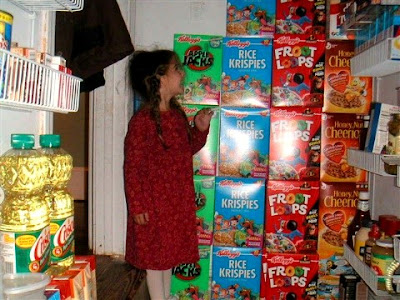
Emily in 2004 with the Wall o'Cereal after a big Kellogg's sale

Emily in 2004 with the Wall o'Cereal after a big Kellogg's sale. She was as old then as Gretta is now.
{Cue the violins with "Fiddler on the Roof"....}


Above head level on that wall, I've hammered a few nails into a (painted) plank of wood that is attached to the drywall.


These nails are perfect for hanging the net bags that hold heavy produce, such as onions and potatoes.


This is also where we keep the plastic coffee-cup lids, and bulk-purchased plastic bread bags, suspended by plastic bags, hung on mug hooks.


What are your Pantry storage solutions?


Please share them in the comments!


Works for Me Wednesday header at rocksinmydryer.typepad.com(This post is part of the Works for Me Wednesday group writing project.)
Here are the rest of my contributions to the WFMW project.

Tuesday, August 28, 2007

Filing printable receipts electronically with a PDF printer driver

Being able to work with .PDF files is endlessly useful.

The nice thing about .PDF files, is that they look the same on everyone's computer.

For example, someone with Hebrew fonts in their word processor, can create a .PDF version of a document (say, a flyer) with Hebrew in it that can be read on someone else's computer, even though the recipient doesn't have any Hebrew fonts.

If the recipient prints the flyer, it will print correctly on their system and with their printer, without fuss.

Mac users have .PDF capability built into their systems, but Windows folk (like me) have to add it. Luckily, there are many cheap/free and easy methods.

I have been using various .PDF creating printer drivers for a number of years. These are free (or minimal cost) utilities that create .PDF files from anything you can print from your computer.

They work by installing a .PDF-creating "printer" on your system. To make a .PDF file, simply choose this "printer" when printing from any program. Instead of printing on paper, you will be asked for a file name/location of the .PDF file that holds whatever the program would have printed.

I use easyPDF. It has a free version, but I paid $9.95 for a bit more functionality from it a few years ago. There are many free PDF printer utilities available.

Lifehacker recently shared a list of 10 free PDF utilities.

One of the many nifty way to use a .PDF printer driver, is to use it to avoid printing (and losing) paper receipts when shopping or banking on-line. Obviously, if it is something for which you need a physical copy, such as for tax purposes, then print on paper.

Create a folder (in My Documents) called "Receipts". Whenever you buy something or sign up for something on-line that yields a receipt page - you know, the ones that say "Print this page for your records" - simply print to the .PDF driver and save the file to the Receipts folder.

Voila! Now, all those confirmation receipts are stored together. You'll be able to find them, sort them, forward via e-mail, and use text-select to copy and paste data (such as order numbers).

Emptying my head to reboot my Project List

Photo of Boston's John Hancock Building, taken by Juggling Frogs August 26, 2007

I normally keep the list of my current projects in quasi-electronic form, as part of my hybrid(Outlook/Moleskine) system.

Every so often, however, my Project List needs a therapeutic overhaul.

The usual trigger for this is when my list of things to do looms too large for me to have clear mental picture of its structure.

This can happen when:

  • many projects have been completed
  • many new projects are anticipated
  • the holiday season is approaching
  • the holiday season is just passed
  • major responsibilities are shifting
  • schedule changes are coming
  • scheduling milestones occurred
  • it has been a long time since the last "reboot"

For me this morning, I'd check 'all of the above' in that list.

It helps to take an hour or two to get a handle on the status of... everything. This is a step further back from the 'weekly review'.

My approach is to go temporarily low-tech. I grab the past few months' worth of notebooks, their index, an updated printout of the upcoming calendar, along with printouts of project specific schedules, and the latest updated Project List, and step away from my computers, away from my desk.

I clear the dining room table and put up a pot of coffee. This lets me pretend I'm at a coffee shop, free from the (home) office and its distractions. The printouts and lack of laptop help keep me on-task and off-line - both from the Internet, and from the wheel-spinning obsessive editing of the Project List that sometimes clouds my view of the bigger picture.

photo of Project Chart in the making
On a large sheet of paper (small poster-board), I draw a grid of generic sections with a thick marker. These sections represent projects.

Using sticky-note page markers, trimmed tops of sticky-notes, or strips of paper and a restickable glue stick, I dig methodically backward and forward through my notes, populating the project sections on the big, blank project chart with next actions on the little, removable slips of paper. (An approximate color coding is helpful, but only if I'm vigilantly non-perfectionistic about it.)

The newness of the empty chart, and the temporary nature of the paper slips, allow for quick shuffling and a global view of the growing list. At this stage, the printed Project List is used as an input to the Project Chart-making process.

When completed, I use the chart to update the Project List on my computer. Thus, the Project Chart now becomes the input to the Project List.

This step is vital. It's important to complete the cycle, and finish the "reboot" with a single updated, functioning Project List.

If the process is interrupted, the temptation to use the Project Chart as a working Project List will be very strong. This is a huge mistake, as it effectively creates two, out-of-sync Project Lists.

If I'm interrupted, I mark down where I left off, and use my regular tools (notebooks, calendars, project lists) in "real life", restarting the chart-making process (with updated printouts, if necessary) when time permits.

Admittedly, I sometimes sneak a digital picture or multi-page scan of the completed chart once it has been used to update the Project List., ostensibly for "backup", but, truthfully, I find it hard to discard my creation (and the work it represents) without a proper tribute.

The last step is the gleeful and cathartic tearing off and crumbling up of the little slips of paper. This prevents the Project Chart from impersonating a Project List. This also allows the Project Chart to be tucked away and reused, the next time I need a reboot.

May all your systems run clear in the upcoming (academic and Jewish) new year.

(See also my annotated picture of a (recycled, homemade) magnetic clipboard for multiple temporary to-do lists for a way to 'empty the head' while in the thick of a complex project.)
Sunday, August 26, 2007

Kosher Cooking meta-Carnival (KCmC?!)

Kosher Cooking Carnival (KCC) logo

Table of Contents~ Breads~ Salads ~ Appetizers ~ Soups ~ Side Dishes~ Entrees(Meat) ~ Entrees (Dairy) ~ Entrees (Pareve) ~ Desserts ~ Snacks ~ Condiments ~ Beverages ~ Recipe websites and lists ~ Articles about Food, Cooking, and Celebrating ~ Articles about Keeping Kosher ~ Cookbooks ~ Just for Fun ~ KCmC Index

In the almost two years since Batya started the Kosher Cooking Carnival, it has reliably provided a cookbook's worth of new articles and recipes every month.


I had the privilege of hosting this month's edition. In the process of collecting the previous carnival's links (to avoid duplicates), (and also to help me find recipes for my own use) I started to compile an aggregate recipe index from the previous Kosher Cooking Carnivals.


Until attempting this, I had no idea how large it had grown!


What follows below is either a KCmC (Kosher Cooking meta-Carnival) or a KCMC (Kosher Cooking Mega-Carnival).


Thank you, Batya for creating, maintaining, and nurturing this incredible ongoing collaboration!You should be very, very proud! All of our tables have been enhanced by your efforts!


Past posts and future hosts, as well as a submission form for your recipes can be found at the Official Kosher Cooking Carnival index page.


Table of Contents:


Breads


Salads


Appetizers


Soups (and soup accompaniments)


Soup +/- matza balls


other than chicken soup


Side Dishes


Entrees (Meat)

Beef (other than Cholent)

Poultry

Cholent


Entrees (Dairy)

Entrees (Pareve)

fish

not fish

Desserts

Snacks

Condiments

Beverages

Recipe websites and lists (not all are specifically kosher)

Articles about Food, Cooking, and Celebrating

Articles about Keeping Kosher


Cookbooks


Just for Fun


Here is the list of the Kosher Cooking Carnivals included in this index:


Table of Contents~ Breads~ Salads ~ Appetizers ~ Soups ~ Side Dishes~ Entrees(Meat) ~ Entrees (Dairy) ~ Entrees (Pareve) ~ Desserts ~ Snacks ~ Condiments ~ Beverages ~ Recipe websites and lists ~ Articles about Food, Cooking, and Celebrating ~ Articles about Keeping Kosher ~ Cookbooks ~ Just for Fun ~ KCmC Index


Past posts and future hosts, as well as a submission form for your recipes can be found at the Official Kosher Cooking Carnival index page.


Disclaimer: If a link was not functioning when I checked it, I tried to fix the link or find the update. If I couldn't get a link to work I didn't include it. I also left out any links that required registration to view. Everyone is encouraged to visit the KCC posts themselves for further discussion of the recipes in the comments. It took a long time to edit and check links, so I can't promise to keep it updated. (Maybe after KCC#30?)

Index of Recipes on Juggling Frogs


Table of Contents~ Breads~ Salads ~ Appetizers ~ Soups ~ Side Dishes~ Entrees(Meat) ~ Entrees (Dairy) ~ Entrees (Pareve) ~ Desserts ~ Snacks ~ Condiments ~ Beverages ~ Recipe websites and lists ~ Articles about Food, Cooking, and Celebrating ~ Articles about Keeping Kosher ~ Cookbooks ~ Just for Fun ~ KCmC Index
Yom Tov cooking strategy: Bake kugels in muffin tins

One entertaining strategy that helps me manage the holiday cooking season is to cook kugels in muffin tins. (I call them "Kugelettes".)
This allows the unused portion to be served as "new and unopened" at a subsequent meal. They can be frozen and defrosted in portions as needed.

If there are just a few types of various kugels left, they can be served together on a tray as a kugel assortment.

(Shown above: Noodle Kugelettes made in a regular cupcake pan (upper left) and Challah Kugelettes made in a mini-bundt pan, displayed on the beautiful and original fish plate that my sister made for us (foreground, lower right). )

Friday, August 24, 2007

Shabbat Shalom!


Please note: this blog is not updated on Friday nights or Saturdays. Comments made during this time will be put in a queue, to be moderated after Shabbat.

Shabbat Shalom! שבת שלום

Thursday, August 23, 2007

Adventures in melted chocolate: Letters and Cups

To make a chocolate message with individual letters:


  1. Write or print the message on a sheet of paper.

    If using a printed message, use a simple font, and set the attributes to "bold" and "outline". If you wish to center the message on a cake, center it on the page, too. This will prevent having to calculate how to line things up on the cake later.
    Using a printed image helps make the font and spelling consistent.

    If you choose not to use an "outline" font, then try to print the message with a color that is very different than chocolate! (For my Hebrew lettering of "Chag Sameach" ("Happy Holiday") shown below, I used pink. Black letters are hard to distinguish from the chocolate, and often result in unwanted holes in the letters.)


  2. Place the paper on a cookie sheet, and cut a sheet of waxed paper to fit over it. Tape the waxed paper in place.

    Alternatively, a piece of strong cardboard or foam core board can be used instead of the cookie sheet. This template will be reusable, so the cardboard-message-waxed paper kit can be saved for later re-use. This works well with common message ("Happy Birthday!") that will see frequent enough use to justify storing the board.

  3. Melt a package of chocolate chips in a microwave safe bowl, by heating at half power for a minute or two. Stir them until the chocolate is smooth and pourable.

  4. Place a strong plastic bag or (preferred) a disposable piping bag inside a drinking glass. Fold the top of the bag over the outside of the glass. This will hold the bag open to receive the melted chocolate.

  5. Fill the bag less than 2/3 full.

  6. Twist the top third of the bag to keep the chocolate from oozing out from the top.

  7. Snip of the smallest bit of the corner of the plastic bag that allows for a smooth flow of chocolate.

  8. Use a firm and constant pressure to outline a few of the letters of the message in chocolate. By the time a few of the letter outlines are done, the thin lines of chocolate will have hardened, giving structure to the letter that will prevent the
    chocolate from flowing outside the outline.

    Go back and fill in the letter middles when the outlines are hardened.

  9. If you make a mistake, the chocolate can be fixed with a toothpick while it is still melted.

    Resist the urge to use your finger! There will be plenty of chocolate in the bowl to nosh on later.

    If you forget and use your finger, you'll have to wash your hands before continuing. If you do that, be sure to dry them very well before resuming any chocolate-related activities. The tiniest bit of water will dull the chocolate.

    Don't touch the chocolate with wet hands.

  10. The letters take very little chocolate. It pays to have a few other board-pages set up, to make a few chocolate messages for later.

    The chocolate will keep well in a sealed container, kept cool, (room temperature) dry place.


Some advantages to this method:
  • Chocolate messages are nice for those who don't like the uncertainty of writing in frosting.

  • The letters can be placed on other desserts, such as fruit, ice cream, or sorbet.

  • It is much easier to find pareve chocolate chips than pareve frosting.

  • These can be made with high-quality chocolate.

  • Chocolate tastes better than frosting.

  • Since the message is written first, it will fit on the cake!

  • Mistakes can be melted again for another turn.

  • These letters are made in advance, away from the cake.

  • They can be put on a store-bought frosted cake. It is easy to transport the chocolate message to another town, buy a cake last-minute at a bakery or supermarket, and add the message later.

  • The letters can be removed from the cake, allowing the message to be saved. (Like having your cake and keeping the message part, too!)

  • This is workable solution for when the bakery is unlikely to be able to write in Hebrew.

  • Since the only food-equipment needed (other than the disposables) is a microwave safe container and a bag of chocolate chips, these can be made on-site at a school's kitchen, in cases where home-baking is not allowed. (Or in a non-kosher kitchen, CYLOR)


To make chocolate dessert cups:


Melt chocolate in a microwave safe bowl at half power for a couple of minutes. If making chocolate message also, do the message part first, and make the cups afterwards.

The letters use very little chocolate. One 12 oz. bag of chocolate chips makes (approximately) 24 mini-cups.

Any cupcake pan will work, but the new silicone pans release the chocolate beautifully. They can be stretched and pulled without breaking the chocolate.

When I used to do this with regular mini-cupcake tins, I assumed I'd have 25% breakage. (Broken cups can be re-melted for a second chance.)

With the silicone pans, I have about 1% breakage!


I let the girls make these with the silicone pans. I wouldn't with the metal pans, because it's too frustrating for them, wasteful (of time and chocolate), and annoying for me to keep saying, "NO! You can't eat all of the broken ones!"

Smear the chocolate inside the cupcake molds, making sure to cover the whole inside of the mold, and allowing for a fully coated, but not too thick layer on the bottom of each cup.

(If you made a message first, you can just use the pastry bag to squirt the chocolate in each cupcake cup. This makes this whole project very clean, fast, and easy.)

Take a rubber spatula and smooth the edges of the mold, removing the inevitable bits of chocolate that have dribbled past the sides of the cupcake cups.

Silicone molds are flexible, and need to be supported by a cookie sheet.

Refrigerate the chocolate for half an hour, or allow to cool at room temperature for a couple of hours.


When the chocolate hardens, gently pop the finished cups from their molds. Do this onto the cookie sheet, as there will be lots of little chocolate shavings on the counter. These shavings can be re-melted.


Mazal Tov!


My husband isn't a great cake fan, and we still have half of his birthday cake in the freezer from last week. So, for our anniversary, I went for the straight ice cream and dark chocolate alternative...

The word "anniversary" was too long to fit on one of my regular serving platters, so I made a disposable cake platter from a shipping box, covered with a recycled scrap of wrapping paper.

Since the ice cream might melt a bit, I "laminated" the top with packing tape, to make it water- (and ice cream-) resistant.

The chocolate letters rest on small scoops of his favorite flavor of ice cream, held by the little chocolate cups.

This project used less than one bag of chocolate chips and less than a pint of ice
cream. (Thus, the whole message cost about $2 to make, platter included.)

The chocolate cups and the letters survive the freezer nicely, so it is easy to make this in advance. Cover the frozen message if it is going to stay in the freezer (especially a frost-free freezer) for more than an hour or two.


By the way, my husband and I were married twenty years ago today! Mazal Tov!


Related posts:

Use the bathroom mirror as a dry-erase board


I've mentioned before about how we keep track of medications when the whole family gets sick, (that post has a downloadable chart to post on the inside of the medicine cabinet door). Using that chart is a lifesaver when there are many people involved, or when the flu settles in for a week.

For one child with a head cold, however, it may be overkill. For short-term, one-child medication tracking (or for scribbling down profound revelations that occur during a shower or toothbrushing time), a dry-ease marker turns the bathroom mirror into a white board.

Wednesday, August 22, 2007

Outfit organizing labels

In order to get our clothes organized both for back-to-school and for the upcoming Jewish holiday season, today's project was to make outfit organizing labels.

These labels wrap around a couple of hangers (that hold the outfit - top, skirt, etc.) to reserve the clothing for future use. Doing this while it's still Summer will help us inventory what we have, and make lists to acquire what we don't. At least that's the plan.


How to make the labels:


  1. Download the desired label files and print a copy on card-stock for each child:
    The weekday labels have either Sunday through Shabbat, or Sunday through Saturday. I uploaded two versions of each of the label files: one with very thin outline fonts (for kids who want to color the words, using the outline as a guide) and the other with the fonts filled in (to be used either as is, or with the background colored in.)


  2. Have the child(ren) color the page.


  3. Cut out each label on the dark lines.


  4. "Laminate" each label with packing tape. (If using laminating sheets, laminate and then cut. If using packing tape, cut and then "laminate".)


  5. Punch a hole in the laminated label.


  6. Bend a pipe cleaner (a.k.a. "chenille stem") or twist-tie in half. Thread it through the hole in the laminated label, with the bend at the hole, facing the larger part of the label. Twist it a few times at the outer edge of the label to secure.


  7. To use, take the two loose pipe cleaner ends and gently twist around the hangers that make up a day's outfit.


We also made a bucket to hold the labels, by punching a couple of holes in a yogurt container, covering it with duct tape (for aesthetics only - we could have painted it, but were short on time today) and making a handle out of two pipe cleaners. (It's helpful to have these in a contrasting color from those used in the labels.)


This bucket can hang on the end of the closet pole, or from a hanger.


I don't know if all this will work, but the girls were excited to make the labels. It gave us a full morning project, because they were very intent on decorating the labels.


Related posts:

A grateful knot of kosher frogs...

Many thanks to Batya for asking me to host this month's Kosher Cooking Carnival, and a special thanks to Mr. Bagel Blogger (Aaron, whose "links are always fresh!") for creating this fantastic graphic to publicize it!Mr. Bagel Blogger's awesome Juggling Frogs KCC sign

I particularly like how these kosher frogs are eating matzah balls and ignoring the insects!

Note to family members: Mr. BagelBlogger gave the chef frog in the picture 21 froglets to juggle, representing the 21 KCC editions. No need to worry that our little knot of frogs has expanded from colony to army!

Tuesday, August 21, 2007

Kosher Cooking Carnival #21, anticipating Tishrei 5768

Welcome to the 21st edition of the Kosher Cooking Carnival!
Setting the Table


  • The Nechama Greisman Anthology has many articles about preparing for the holidays, both spiritually and logistically.
  • My sister, Kosher Newbie is posting again. This will be her first set of Tishrei holidays in her (relatively) newly kosher kitchen. I'm so proud of her!
  • Some of my favorite on-line (not specifically Jewish) recipe resources include: 101 Cookbooks, Recipezaar, and Baking Bites.

Kiddush

Making Motzei

Simanim (significant omens)

Soup

Main Course


Side Dishes

Dessert


Dinnertime Conversation

Cleaning Up

This concludes the 21st edition of the Kosher Cooking Carnival. The September KCC (#22) is scheduled for at Batya's blog, me-ander.


May everyone be written and sealed for health, happiness, peace, and prosperity in the coming year.

May all of your holiday meals be delicious, joyful, and shared with good company.

Don't forget to check out the previous editions of the Kosher Cooking Carnival:


Index of Recipes on Juggling Frogs


Butterflies are (almost) free...


  • This morning we kept 6 kids, aged 3-15, happily occupied for hours, with minimal clean-up, snack included, for about $3.


    To make a butterfly:

    1. Place two pretzels on a wax-coated paper plate, touching at the single round part, with the double parts facing outward to make the wings.


    2. Dip raisins and nuts in melted chocolate chips and place them in a symmetrical pattern on the wings.


    3. With a spoon, drizzle a bit of chocolate across the middle to make the body and head, forming antennae (not too thin) on the plate.


    4. Allow the chocolate to harden at room temperature for half an hour (or refrigerate if in a hurry) and gently remove the completed butterflies from the plates.


    For our crowd this morning we spent:


    25 cents' worth of pretzels (bought in bulk for the school lunches) + $1.69 for a bag of chocolate chips, $1 for a disposable tablecloth (cheaper than therapy and strongly recommended), a dozen wax-coated paper plates, and handfuls of edibles from the back of the pantry.


    Tips for doing this with a crowd:


    • For the edibles, we used the remainders of jars of sprinkles, raisins, blueberries, peanut butter, the bottom of the bag of sliced almonds, etc. Small amounts, like a quarter cup, are fine. Butterflies are detailed work, so the don't use very much of anything.


    • Melt the chips in a glass container in the microwave, heating at half power for 1-2 minutes. Stir and let it cool a bit to prevent burns.


    • Give each child a wax coated paper plate, and write the child's name on it.


    • Stand back and let them go nuts. This will keep all ages entertained and occupied for hours. (Periodic reheating of the chocolate may be necessary.)


    • The chocolate will harden at room temperature. Make them wait a couple of hours to eat their creations as an afternoon snack, as it builds excitement. There will, of course, be some grazing at the table. Gently admonish the noshers and make them wash their hands if they eat the ingredients. This keeps the supplies available, prevents stomache aches and spoiled nutrition, and lets the result become the afternoon snack.

    • Guard the cooling butterflies well. Don't forget that three year olds know how to move chairs to reach the counters!


    Related posts:
    Adventures in melted chocolate
    Index of Recipes on this site

    Works for Me Wednesday header at rocksinmydryer.typepad.com(This post is part of the Works for Me Wednesday group writing project.)
    Here are the rest of my contributions to the WFMW project.

Sunday, August 19, 2007

She's Baaaaaaaack!

After a three-month posting hiatus, my sister, Kosher Newbie, has finally posted again.

Everyone, please shower her with love and comments, so she'll feel too guilty to leave us in the lurch again.

Filling the freezer for Elul: Temporary cake plates

It's hard to believe, but it is already (Hebrew month of) Elul, which means that there is less than a month before the beginning of the month-long marathon of Jewish Holidays that begins with Rosh Hashanah. Thus, it is time to start filling the freezer in preparation.

I like to make and use disposable cake boards for this. These platters allow the freezer space to be used very efficiently, while protecting the cake from breaking. Depending on the formality of the meal, the frozen cake can either be slipped with its doily onto a regular serving platter before defrosting, or served directly from the foil-covered platter (especially outside, in the sukkah).

I make the platters from whatever scraps and boxes are cluttering up my front hallway, during the weeks leading up to the holiday season. The white board below is a scrap left over from one of our doll house making projects.

The shipping box makes a nice platter, as long as the cardboard is doubled, with a separate piece placed inside the fold in the opposite direction of the box's natural fold. This gives the platter enough strength to hold the cake. (For detailed instructions, see the two-tiered cupcake platter version.)

Bad things will happen if you try to use a single layer of cardboard. (Ask me how I know...)

I get the best results from freezing the cake without a cover for an hour or so, before covering with a plastic bag or plastic wrap. This lets the surface of the cake solidify, without the plastic bag sticking to any frosting or decoration.

When it comes time to defrost, remove the plastic bag as soon as the cake is removed from the freezer, and allow the cake to defrost either under a hard cover, or in open air.


Reminder: Kosher Cooking Carnival #21 Call for Submissions

Kosher Cooking Carnival #21 is coming shortly!
This month's edition is hosted here, at Juggling Frogs
Kosher Cooking Carnival logo
This will be the Holiday edition of the carnival, so please share your favorite Rosh Hashanah, pre-fast, break-the-fast, and Sukkot recipes and kosher food related articles with us! This is just a suggestion, of course; submissions do not need to be holiday related.
Also, anything shmitta-related would be appropriate for the upcoming shmitta year.

The deadline for Kosher Cooking Carnival #21 is TOMORROW, Monday, August 20, 2007. Please submit your kosher recipes and food related articles directly through the blog carnival form (preferred), or you can e-mail to me directly at carnival@JugglingFrogs.com.

To inspire you to send me your submissions, I'm including the list of the previous Kosher Cooking Carnivals. Check them all out, they're full of great recipes and interesting articles. :


Recipe for Carrot Cake (pareve, uses food processor)

This dark and moist cake goes together very quickly, using the food processor - first to shred the carrots, and then to mix the dough. It is not too sweet, and it freezes well.


To serve this after a meat meal (or to pretend it is a honey cake during the Jewish High Holiday Season), we like it topped with honey frosting. Otherwise, any traditional (dairy) cream-cheese frosting will compliment it nicely. It is excellent unfrosted, too.

[begin off-topic carrot-cooking-related digression]

Instead of trying to guess the amount of carrots needed, I cheat: I scrape the skins from a whole bag of carrots, shred half, measure out the amount needed, and save the extra shredded carrots for making kishke.


Making kishke involves pureeing a couple of carrots, so using shredded carrots doesn't affect the results. To make sure I have the right amount of shredded carrots as whole-carrot equivalents for the kishke, I weigh a couple of the remaining whole carrots, and use that amount of shredded carrot in the kishke recipe.

The rest of the peeled carrots go in other recipes (cholent, soup, salads, etc.)

This sound complicated, but the bulk preparation of ingredients saves much time. I'm always looking for ways to streamline the preparation of multiple concurrent recipes.

[end off-topic carrot-cooking-related digression]

Depending on the size of your food processor, this recipe can be doubled.

Ingredients:


  • Group A:
    • 1.5 cups grated raw carrots
    • 2 Tablespoons lemon juice (fresh not required, but preferable)
    • 1/2 can crushed pineapple (6-8 oz.) - or can puree the pineapple from chunks or rings in the food processor - well drained.
  • Group B:
    • 1.5 cups all purpose flour
    • 1.25 cups sugar
    • 1 teaspoon baking powder
    • 1 teaspoon baking soda
    • 1 teaspoon salt
    • 1 teaspoon cinnamon
    • 1/2 teaspoon ground cloves
    • 1/2 teaspoon ground ginger
    • 1/2 teaspoon ground nutmeg
    • 1/2 teaspoon ground allspice

  • Group C:
    • 3 eggs
    • 3/4 cup oil
    • 3/4 cups raisins

Instructions:

  1. Preheat oven to 350 degrees F.
  2. Grease and flour 2 large loaf pans (9"x5"), or one smaller loaf pan (8.5"x4.5") and a bunt pan.
  3. Mix Group A items in a large bowl and set aside.
  4. Use food processor with the metal blade to mix Group B items by processing for a few seconds.
  5. Add Group C items to Group B, one at a time, processing to incorporate between each item (and each egg).
  6. Add the Group A items to Group B in the food processor, and process until well incorporated, about a minute.
  7. Pour the mixture into the prepared pans and bake at 350 degrees F for 40-45 minutes,\. Cakes are done when the edges pull away from the side of the pan, or a toothpick comes clean of batter when inserted in the middle of the cake.


Enjoy!


Index of Recipes on Juggling Frogs


Recipe for Kishke (vegetable loaf) (pareve)

With a food processor (or blender), making kishke is almost too easy. I can't believe I ever used to pay $3-$6 for a small, frozen, salty, flavorless, preservative-laden loaf!

This is a side dish that gets cooked in the crockpot with the cholent (an overnight-cooking stew, often served on Shabbat/Saturday lunch).

This recipe makes two large (or three medium-sized) loaves, which can either be frozen (after they are baked) directly in the aluminum foil, or used right away, to put (while still in the foil, and/or still frozen) in the crockpot with the cooking cholent on a Friday afternoon for Saturday's lunch.


Ingredients:


  • 1 cup oil
  • 4 stalks of celery
  • 4 carrots
  • 2 onions
  • 3 cups flour
  • 2 teaspoons salt
  • 2 teaspoons paprika
  • 1/2 teaspoon freshly ground black pepper (even better: freshly ground black/red/white peppercorn mixture)

Instructions:

  1. Preheat the oven to 350 degrees F.
  2. Puree vegetables in the food processor (or a blender) fitted with the metal blade.
  3. In a very large and separate bowl (separate mostly because this is a large yield recipe, unlikely to fit in the food processor bowl, but so easy to make and nice to have a couple of extra kishkes in the freezer for little extra effort, clean-up and expense) mix the dry ingredients (flour, salt, paprika, and ground pepper).
  4. Add the pureed vegetables to the dry ingredients and mix to incorporate.
  5. Grease a large piece of aluminum foil for each kishke loaf. The grease should cover all of the middle, and up to the edge of the uppermost side of the foil.
  6. Place the mixture on the greased foil in a line. Roll the foil once over the mixture, tuck in the ends, and continue to roll the foil until the wet mixture is well secured.
  7. Bake the foil encased mixtures, secured on a cookie sheet, for 45 minutes at 350 degrees F.
  8. Freeze for later, or place in the crock-pot on top of the cholent.
  9. (To cook as a side dish without the cholent, can bake for 1.5 hours instead of 45 minutes.)


Enjoy!


Index of Recipes on Juggling Frogs

Friday, August 17, 2007

Shabbat Shalom! שבת שלום


Please note: this blog is not updated on Friday nights or Saturdays. Comments made during this time will be put in a queue, to be moderated after Shabbat.

Shabbat Shalom! שבת שלום

Disposable tiered cupcake platter (recycled)

This is a cheap frugal environmentally responsible way to bring cupcakes to a picnic or someone else's house, without having to keep track of the platter.


The platter is made from a used shipping box, a torn gift bag (or foil, comics from the newspaper, or salvaged gift wrap), some packing tape, and two paper doilies (optional).

I timed myself as I made it this time, and it took about 10 minutes, including snapping the photos.

This is also a great way to fit many cupcakes in the freezer before delivery.


Disassemble the box. I'm going to call the panels A B C and D. The doily is 12" in diameter. It fits on panel A, with the middle and a bit of one of the sides.


Cut the disassembled box between panels B and C, resulting in
two double panels: AB and CD.


Using the AB piece, trim one of the flaps from the A panel and the same part from B panel. The AB will be roughly 2/3 as long, with A and B still attached to each other.


Open the AB panels with the outside of the box face up. Tape the parts that were just removed to each of A and B, over the fold. The goal is to make the fold not work anymore, resulting in cardboard panels that don't bend.

Fold panels A and B together, with the taped-on parts in the middle. Secure the folded AB (now 2/3 of a panel in size, doubled most places and reinforced in the middle) with tape all around. This is the bottom tray.

With panels C and D, do the same as with the pair of panels A and B, but this time, remove both flaps, using only the middle parts, folded together (with the inside of the box facing out), to make a smaller top tray.

Taking one of the discarded panels from the CD pair, trim its width to the height desired between the two trays. Leave its length intact.


Take this piece and fold it in half, width-wise.

Open the fold, and fold the edges into the middle. This will result in three folds, with four sections.


Overlap two of the sections to form a triangle and tape to secure. This is the pedestal that holds the top tray.


Trim one of the (optional) doilies to make a compatible, smaller doily for the top.


The trays can be covered with aluminum foil, recycled gift wrap, comics from the Sunday newspaper, etc. This time, I used a torn and written-upon recycled gift bag. Gift bags are great from this, because they are usually made from a large sheet of strong decorative paper.

For best results, use a bag that, when closed, is at least as large as the bottom tray. This will allow a single bag to cover the entire project, and for the project to be covered by unfolded paper (which looks nicer).


Cover the two trays and tape to secure. Don't worry if there isn't enough paper to cover the bottoms. Tape the doilies in place. The doilies are great for covering up the rips or writing on the bags.

Cover the triangular pedestal, leaving it hollow - don't cover the triangle at the bottom.


Tape the pedestal to the bottom of the top tray. Then, run three pieces of tape inside the three inside sides of the pedestal. It was hard to show in a photo, but in this picture, my thumb and fore-finger are each touching the sticky part of tape. The third piece is hanging over the third edge.


Invert this onto the top of the bottom tray to secure. If more tape is needed, go for it.

Remember, it's going to be covered in cupcakes and then discarded. Any over-engineering with clear packing tape will be invisible. I promise not to tell anyone.


The Internet has driven me insane...

toilet paper origami
Admittedly, it was a short trip.

But why else would I have spent almost ten minutes on a Friday morning folding toilet paper?


(Well, okay, it might have something to do with toilet training my daughter, and the associated extra bathroom time...)

Recipe for Honey Frosting (pareve)


Honey cake season is just around the corner. For those who are not great fans of honey cake, this is my strategy to be "yotzei" honey cake, without having to bake tons of cloyingly sweet cakes. (This way you can bake your cakes and eat them, too, rather than bake cakes and have them sit. Ugh. Sorry.)

This way, you can bake your favorite cakes, smear a bit of this yummy frosting on top, and declare them "honey cakes" without fear of contradiction.

This recipe makes 2-3 cups of pareve honey frosting, which can be drizzled on top of carrot cakes, spice cakes, quick breads, or any not-too-sweet cake. It can also be served as a "cake condiment" and smeared like a flavored butter onto the cake surface by each individual.

We like this as a pareve substitute for cream cheese frosting on a carrot cake.

Because this frosting is thin and pourable (which suits it well, as a little goes a long way) it looks, tastes, and performs best when the whole cake (or at least the frosting) is served chilled.

A double recipe of 5 cups of this frosting, chilling in the refrigerator, will transform a few weeks' worth of holiday cakes into "honey cakes", a few ladle-fulls at a time!


Ingredients:

  • 1/2 cup honey
  • 1 stick (1/2 cup = 4 oz.) unsalted margarine
  • 1/4 teaspoon salt
  • 1/4 cup soy milk
  • 1 lb. confection sugar (no need to sift if measuring by weight. This is one of the reasons I like to double this recipe: I can just dump in a whole 2lb. bag of the confection sugar without measuring.)
  • 1/4 cup brewed coffee, warm


Instructions:

  1. Cream the margarine.
  2. Mix the soy milk and the honey with the margarine, adding the liquids slowly in small amounts, scraping the sides of the bowl and mixing well between each addition.
  3. Add the salt and the confection sugar and beat well.
  4. Stir in the brewed coffee.
  5. Chill and use sparingly. It will run over the sides of the cake if served at room temperature, so either serve immediately, or keep chilled.


Enjoy!


Index of Recipes on Juggling Frogs

Wednesday, August 15, 2007

Recipe for Disappearing Chicken Salad


This is our family's favorite chicken salad. I make it most weeks on Saturday afternoon, with the remainder of Friday night's barbecue or roasted chicken. It is a great way to stretch a small amount of cooked chicken, to serve a crowd.

We call it "Disappearing Chicken Salad" because leftovers are rare. When there is some left (as there was this week, so I was able to take a photo of it) it always gets eaten the next day; it is never forgotten in the back of the refrigerator.

The ingredients are therefore offered without measurements, as everything is based on quantities available, to taste.

Ingredients:


  • Cooked chicken - can be light or dark meat. Roasted turkey leftovers also work well.
  • For each pound of cooked chicken, approximately 2 apples. (I like Granny Smith apples with chicken, and Red McIntosh apples with Turkey.)
  • For each pound of chicken, a few handfuls of raisins, to taste
  • Lemon juice (bottled is fine, as it is just for keeping the apples from turning brown.)
  • Mayonnaise
  • Curry powder (optional; omit if serving this dish to children)
  • Other optional additions: celery, pecans, mandarin oranges (especially nice when substituting dried cranberries for the raisins.)

Instructions:


  1. Fill a large bowl halfway with ice water. Add a few tablespoons of lemon juice.
  2. Wash the apples well, but do not skin them. Dice the apples and place them in the icy lemon water immediately.
  3. Dice the chicken.
  4. Remove the apples from the icy lemony water and discard the water (or use it to make lemonade).
  5. Mix chicken, apples and raisins with as little mayonnaise as possible to hold the ingredients together.
  6. Season with curry powder (unless planning to serve it to children.)
Enjoy!


Index of Recipes on Juggling Frogs

Wands Aplenty


Thanks to this great tutorial published by DadCanDo, we had a lot of fun making these quick and clever wizard's wands last night from a single letter-sized sheet of paper (each), paint and a glue gun.


Check out his excellent and clear tutorial for many (much more impressive) versions of this project. I'm filing this idea away for Purim, since we have a couple of Harry Potter fans in residence.


(This picture has three wands in a drinking glass, waiting for the paint to dry.)


Tuesday, August 14, 2007

Recipe for Soft Pretzels (pareve, uses bread machine)

With the dough made in the bread machine, this is a kid-friendly activity masquerading as a snack. I've adapted the recipe from the "Electric Bread; A bread machine activity book for kids"
Ingredients:
Dough:

  • 1 cup water
  • 3 cups all purpose flour
  • 1/4 cup sugar
  • 1 teaspoon salt
  • 2 Tablespoons (quarter stick) margarine
  • 1 packet or 1/2 coffee scoop or 1 Tablespoon yeast

Egg Wash:

  • 1 egg
  • 2 Tablespoons white vinegar

Optional Toppings for sprinkling on top of egg wash before baking: (few Tablespoons, to taste)

  • Kosher salt
  • Cinnamon and sugar
Instructions:
  1. Place dough ingredients in bread machine set on "dough" setting.
  2. Hand out portions of dough to each child for shaping. Give each child a (optionally foil lined) ungreased baking pan. For best results, suggest that dough shapes of similar widths are grouped together on baking pans. (i.e. all the tiny, thin pretzel shapes on one pan, all the fat ones on another.) This allows for more even baking times.
  3. Let rise for one hour or until doubled in bulk.
  4. Preheat oven to 375 degrees F.
  5. Just before baking, brush each pretzel gently with the egg wash, and sprinkle with the optional salt or cinnamon sugar, if desired.
  6. Bake until golden brown, 12-18 minutes.
  7. Cool for 5-10 minutes before serving.


Index of Recipes on Juggling Frogs

Doll house sized Stroller Tutorial

This article includes instructions for making three types of doll house sized strollers from
Popsicle sticks and Must Gum boxes. (Any small cardboard box will do, such as the individual sized raisin boxes, or match boxes, etc. The box should be large enough to hold the baby dolls.)doll house sized Toy Stroller Tutorial

In these instructions, the green stroller is a single stroller, the blue is a double side-by-side stroller, and the pink is a double front-to-back stroller.
We used a glue gun (handled by an adult or teenage child) because we're an impatient (not "inpatient" - Thanks, Margo, for both the correction and the giggles!) clan (where toy making is involved), but any glue will work, given enough drying time between steps.

The instructions for the single stroller are the most detailed, with the two double strollers as variations.

They are of a size that works with 1:12 (1"=1') scale sized dolls, such as Fisher Price/Preskool Loving Family or standard doll house sized dolls.

This project is predicated on the assumption that the wheels do not need to turn.

Warning: Sexist opinion follows. Do not read this section if such things offend you.

[begin sexist opinion]
I have found in my (admittedly statistically insignificant sample sized) children's experience, that girls don't care that their toy vehicles work. Boys care deeply that the axles and wheels work and make the vehicle go.

My son's first word was "car", and "truck" came shortly thereafter. His first verb was "vroom", as in "car, vroom!!!!" , or later, "Vroom the car, Mommy!"

Determined not to burden my firstborn child with environmentally imposed gender-specific assumptions, I dutifully bought dolls for him.
They all became either passengers or projectiles.

Jonathan's favorite toy vehicles were the ones that ran the fastest, straightest paths. He'd race them against one another; the winner of the race earned the right to lie on his pillow that night.

By the time the girls were born, our house was chock-a-block with toy
bulldozers, cranes, books and videos about construction work, etc. Of course they played with the trucks, but upon closer observation, it was clear that they played with them differently than my son and his male friends.

The girls would sit in a circle, each having chosen their favorite toy cars. The cars and trucks would talk to one another. They had relationships and dialog with the other cars.
Witnessing his former hotwheels kissing the other cars goodnight, my son, watching from the threshold of the girls' room, would roll his eyes and walk away in disgust.

Thus, this project depends on my girls' view of doll house toys. These strollers have wheels, but they don't turn. So far, after years and years of making them this way, nobody other than my son has noticed or complained about it.

[end sexist opinion]

So, if you have children of either gender who want strollers that can roll across the kitchen floor, this project is not going to satisfy them. But if your kids want strollers for their dolls whose
wheels turn only in their imagination, these will work nicely.


In these instructions, we have painted the individual steps, rather than gluing everything together first and painting the glued, completed result. This method makes for a tidier result (with all the nooks and crannies filled in with paint, and the inside of the stroller seat clean and unpainted white cardboard), and is quicker for mass assembly of many strollers, but takes longer when making a single stroller.

If we were doing this with a limited time, or a large group of children, we'd glue everything first and paint the result.

doll house sized Toy Stroller Tutorial


Materials used:


  1. For the stroller seat: Small cardboard boxes, such as Must Gum (a popular kosher brand of chewing gum), snack-sized raisin boxes, etc.
  2. For the seat belt: Twist-ties, or bits of pipe cleaners (also called 'chenille stems')
  3. For the wheels: Wooden discs (available at craft stores), metal washers, or (cheapest option, but bothers some people) painted pennies. Foam or paper circles can also be used, but will not be very durable.
  4. For the handles: Popsicle/wooden craft sticks or wooden coffee stirrers. We have also made many strollers from bits of broken plastic clothes hangers
  5. For the seat pad: Paper towels and bits of fabric..
  6. Also: Glue, scissors, paint, paintbrushes, clothes pins.


doll house sized Toy Stroller Tutorial


To make a single stroller:


  1. Use a clothes-pin to make a handle for painting the box. This will allow you to paint the box on all sides. doll house sized Toy Stroller Tutorialdoll house sized Toy Stroller Tutorial

  2. Allow to dry.

  3. Cut out the face of the box.doll house sized Toy Stroller Tutorialdoll house sized Toy Stroller Tutorial

  4. Glue the middle of a twist tie inside the bottom third of
    the box, parallel to the box bottom.doll house sized Toy Stroller Tutorial

  5. Cut the top third with a diagonal cut from two craft sticks. The angles and locations of these cuts should be as close to identical as possible.doll house sized Toy Stroller Tutorial

  6. Glue each cut craft stick to a whole craft stick, such that they are mirror images of
    one another.doll house sized Toy Stroller Tutorial

  7. doll house sized Toy Stroller TutorialAdd a segment (cut to fit) of another craft stick to make each of these shapes into a trussed (triangular) shape. This will give the stroller stability. Paint and allow to dry. We used a paper towel to protect the counter top from the paint. This paper towel will be recycled later in this procedure as the stuffing of
    the stroller seat.doll house sized Toy Stroller Tutorial

  8. Glue the shapes to the sides of the painted box/seat, and glue wheels to the sides. The wheels are decorative only, they won't turn.doll house sized Toy Stroller Tutorial

  9. When everything is dry, the paper towel becomes the padding/stuffing in the stroller seat. doll house sized Toy Stroller Tutorial

  10. Fold the paper towel to slightly less than the width of the box that was used to become the seat.doll house sized Toy Stroller Tutorial

  11. Continue to fold again and again until the entire towel is used. Glue lengthwise to seal. doll house sized Toy Stroller Tutorial

  12. Trim a piece of folded towel to the desired length of the stroller seat cushion.doll house sized Toy Stroller Tutorial

  13. Place the piece of folded towel seam side-up on top of the wrong side of the fabric scrap. (Thus, right side of the fabric and the smooth side of the folded towel are facing the work
    surface.) Glue the sides of the fabric to the folded towel, like an incompletely wrapped gift.doll house sized Toy Stroller Tutorial

  14. When flipped over, it will be an upholstered seat cushion. doll house sized Toy Stroller Tutorial

  15. Glue this cushion in place, right side up, on top of the twist tie.doll house sized Toy Stroller Tutorial

  16. Don't forget to test the final product!doll house sized Toy Stroller Tutorial


To make a double stroller (side-by-side style):


  1. Cut the faces of two painted boxes. They should be as close to identical as possible. We use the cut-out face from the first as a template for the second.doll house sized Toy Stroller Tutorial

  2. Cut four craft sticks at the same angle and location, approximately one third from the top. Use one of them as a template to make sure they are as close to identically cut as possible.doll house sized Toy Stroller Tutorial

  3. Glue two of the cut sticks to either side of a whole craft stick. This will become the middle leg of the stroller, between the two seats.doll house sized Toy Stroller Tutorial

  4. Using this middle piece as a template, glue one of the remaining cut craft sticks to one side of a whole stick, to match one side of this middle piece, and the other remaining craft stick to the opposite side of a whole craft stick to match the other side of this middle piece. doll house sized Toy Stroller Tutorial

  5. Glue a piece of craft stick, cut to fit to each of the three shapes. For the middle piece, glue this piece in between the two angled pieces.doll house sized Toy Stroller Tutorial

  6. Paint the shapes and allow to dry.

  7. Glue the middles of matching twist-ties to the bottom third of the inside of the painted boxes to form the seat belts.
  8. Create a folded towel liner, and locate fabric scraps. For our double strollers, we used a 6.5" square of cotton, cut in half, to make two identical 3.25"x6.5" strips. doll house sized Toy Stroller Tutorial

  9. Cut the folded towel to size and glue the fabric, (as described above in the single stroller instructions) to make a pair of matching upholstered stroller seat cushions. doll house sized Toy Stroller Tutorial

  10. Glue the completed cushions on top of the twist ties inside the seats.

  11. Glue the completed, cushioned seats, to either side of the dried, painted, middle piece.doll house sized Toy Stroller Tutorial

  12. Glue the two side pieces to the outer sides of the two seats. It is important to test this before gluing, to make sure it stands on its own, with all six "feet" touching the work
    surface when the stroller stands alone. If it teeters a bit, it can be fixed by mounting the wheels a bit lower than the feet to adjust, but the toy will last longer and be more durable if this can be avoided.

  13. Cut another craft stick to the width of the back of the stroller, to add another truss. Glue it to the back of the double stroller and paint it.doll house sized Toy Stroller Tutorialdoll house sized Toy Stroller Tutorial

  14. When using metal washers as wheels, clothespins on both sides of each wheel make great clamps. doll house sized Toy Stroller Tutorial

  15. Done! doll house sized Toy Stroller Tutorial


To make a double stroller (front-to-back style):


  1. Cut the faces from two matching painted boxes, and cut four identical diagonally cut craft sticks.doll house sized Toy Stroller Tutorial

  2. Make two pair of mirror image upside-down-Y-shapes, and attach them at the tips, to result in two mirror-imaged but identically-angled and sized M shapes. I like to use the edge of the counter to help align them. doll house sized Toy Stroller Tutorial

  3. Glue them into their M-shapes, one M-shape at a time, using the first as a template (flipped over) to get the angles to match as much as possible.doll house sized Toy Stroller Tutorial

  4. Glue a whole craft stick along the bottom edge of each M-shape.doll house sized Toy Stroller Tutorial

  5. Paint the shapes and allow them to dry. doll house sized Toy Stroller Tutorial

  6. Glue twist-ties as seat belts to the inside of the two seats.

  7. Make upholstered seat cushions using paper towel and fabric scraps (as described above) and glue in place. Glue the two completed seats to one of the shapes.doll house sized Toy Stroller Tutorial

  8. Glue the other shape to the other side of the pair of seats.
  9. Glue on wheels, and you're good to go!


doll house sized Toy Stroller Tutorial

For making many strollers, it helps to do each step in assembly-line fashion, for mass production:doll house sized Toy Stroller Tutorial

The hardest part for us, is making enough strollers in the right colors to satisfy the crowd.doll house sized Toy Stroller Tutorial


Monday, August 13, 2007

Recipe for Berry Tart (pareve)

Although there are a lot of steps in this recipe, they are all quite easy to do. It is best to start this dessert early in the day, because the dough must chill for an hour, the pastry cream should chill for an hour as well. These hours can run concurrently, but the tart shell needs to be baked and cooled before the pastry cream can be added. When completely assembled, the tart is chilled for another hour before serving.

Use whatever fresh and beautiful berries that are available. Frozen berries are not recommended for this tart, as the berries are not cooked in this recipe.


Ingredients:

tart dough ingredientsTart dough:
  • 8 oz. (1 stick) margarine
  • 1/4 teaspoon salt
  • 1 cup all purpose flour

pastry creme ingredientsPastry cream:
  • 1 cup soymilk
  • 1/4 cup sugar

  • 3 Tablespoons all purpose flour
  • 1/4 teaspoon salt
  • 4 egg yolks
  • 2 teaspoons vanilla extract
  • 2 Tablespoons margarine


apricot glaze ingredientApricot glaze:
  • 1 jar apricot jam (preserves, jelly, whatever...)


Berries
  • 2-3 cups fresh berries


Instructions:


  1. Place margarine, salt and margarine in food processor. Process for about 1 minute, when the dough forms a ball on top of the blade.

  2. Wrap the dough and chill for an hour. (I used two recipes for the rest of the pictures in this tutorial, and wrapped them in plastic wrap to save space in the refrigerator. The dough just needs to be covered, such that it doesn't dry out. It doesn't need plastic wrap if your refrigerator has space.)

  3. Preheat oven to 425 degrees F.

  4. Press the dough into the pie pan. This recipe works well with glass pie plates or metal tart (removable bottom) pans. The chilled dough can be rolled with a rolling pin, or just manipulated by hand. It is a very hearty, easy working dough.

  5. Bake the unfilled tart shells for 12-14 minutes at 425 degrees F, until lightly browned.

  6. Set the baked tart shells aside to cool.

  7. Whisk the flour, sugar and salt in a separate bowl.

  8. Heat the soymilk in a heavy-bottomed sauce pan until it is hot, but not boiling.

  9. Separate the eggs and beat lightly. (I'm making a double recipe in the pictures below, so there are eight egg yolks, etc.)

  10. Add a bit of the hot soymilk to the dry ingredients, and whisk to mix. Add a bit more soymilk, mix again. Do this until the dry ingredients are fully moistened and not lumpy.

  11. Put the moistened, mixed (formerly) dry ingredients into the saucepan, where the remainder of the heated soymilk waits.

  12. Whisk the heated soymilk-flour-sugar-salt mixture over low heat, whisking constantly and vigorously, while the mixture boils gently.

  13. Continue until the mixture is very thick and smooth, like a custard.

  14. Remove the pan from the heat, and allow it to cool for a few minutes.

  15. Add the egg yolks to the cooled mixture and whisk to incorporate. (Eggs won't curdle/scramble because the mixture is thickened with flour.)

  16. Return the pan to heat. Boil while whisking vigorously for another minute or two.

  17. Remove the pan from the heat, allow to cool for a minute or two.

  18. Add the vanilla extract and the margarine with the wire whisk, stirring to incorporate.

  19. Quickly after adding the vanilla and margarine, transfer the pastry cream to a different (i.e. not hot) container, place plastic wrap on the surface (to prevent a crust from forming - it should make contact with the pastry cream) and chill for an hour.

  20. While the pastry cream cools, make the apricot glaze. Place the apricot jelly/jam/preserves in the (cleaned out) sauce pan. I use a whole 12 oz. jar for two tarts.
    (Approx. 3/4 cup per tart.)

  21. Heat the jelly until it boils, stirring well to keep it from sticking to the edges of the pan.

  22. Strain the boiled jelly. The result of the straining is the glaze. The jelly's solids can be discarded (I usually sneak them into the cooking cholent, as a 'secret ingredient'.)

  23. Paint the cooled tart shell with a little bit of the glaze.

  24. Add the chilled pastry cream to the glazed tart shell. Smooth the surface so it is even.

  25. Arrange berries on top of the pastry cream.

  26. Brush the berries with the remaining apricot glaze. It should form a thick coat, sealing the berries in place, coating the whole top of the tart.

  27. Chill the completed, glazed tart for at least an hour before serving.


Enjoy!


Index of Recipes on Juggling Frogs

Friday, August 10, 2007

Shabbat Shalom!


Please note: this blog is not updated on Friday nights or Saturdays. Comments made during this time will be put in a queue, to be moderated after Shabbat.

Shabbat Shalom! שבת שלום

Monday, August 6, 2007

Department of Communication Disorders, indeed!

Disgruntled Julie has become linguistically isolated from her family, due to too much time twiddling cell cultures in the lab.

Twenty two years ago, when I was an engineering student, I worked at my school's Department for Communications Disorders, wiring the Psychoacoustics Lab, and maintaining the computers and other electronic equipment used in the lab's basic research.

Mike was an engineer who returned to school to get his Ph.D. in Audiology. This was a bit unusual, as most of the graduate students in the department did not come from a technical background. He shared an office with Mary and Elaine, two 'normal' (i.e. non-geeky) students.

One day, when a series of intermittent noise problems were messing with my network, corrupting data and distorting waveforms, I went to whine and moan about it discuss it with Mike.

ME: I'm having a world of noise problems on the bus. Everywhere I look there are transients. The bus is overcome with transient noise..

MIKE: Did you check to see if the bus is grounded?

ME: I'm trying, but I can't I didn't see any shorts on or near the bus. There are transients all over the bus. If I could just find a way to reduce the noise to an acceptable level... If it were less noisy, I think I'd be okay. The question is, how much noise can the bus stand?

MIKE: (joking) I think you have a poltergeist.

ME: It's so frustrating. I can't figure out how to get rid of this persistent transient noise.

(Throughout this conversation, I noticed that Mary and Elaine were taking an unusual interest in our discussion. They both turned their heads left and right, as if watching a tennis match. )

MIKE: Have you swapped bus connections? What about swapping busses?

ME: Yeah, I've looked at getting different connectors, but I'm convinced it's a systemic problem. I have to try something more drastic. If the bus is blown, I'm in for a world of trouble. {sigh}

I probably should just get rid of the bus now, and hope that the transients disappear. It's not clear what's causing the noise. I wish I knew where it is coming from. The transients might be coming from elsewhere in the system. Swapping busses is probably not worth the effort...yet. It's a good idea, though. Thanks, Mike, I'll keep that in mind.

As I was leaving the office, Mary and Elaine shared a pointed look.

MARY: (alarmed) What are you going to DO?!

ME: (resigned) I'm going to do whatever it takes to get those transients off the bus and stop the noise.

At this point, Mary, Elaine, Mike and I all looked at one another in confusion. Eventually we figured out that while Mike and I were discussing interference from fluctuating unwanted voltages on the wiring for the lab's computer communications network, Mary and Elaine thought we were talking about mounting frustrations with unruly homeless people riding public transportation.

I can only imagine how this would have been received if it had happened today, post September 11th!

Sunday, August 5, 2007

Modeh Ani

Every dawn is a new beginning.

Our challenge is to accept this gift with gratitude and courage.

Sunrise, August 5, 2007

(I didn't realize I caught both the sun and the moon until I uploaded the picture.
We often don't appreciate transitions until we reflect upon them.)

Dawn view of Cambridge, Massachusetts from my bedroom porch, August 5, 2007

Color coded labels help pre-readers (and the rest of us) sort laundry


This is our laundry sorter. A few years ago, I labeled the sections, hoping everyone would sort their laundry. It didn't work.

A couple of days later I realized why it couldn't work. I expected children who weren't fluent readers to read the labels as a matter of course. Fluent readers absorb messages on written signs unconsciously. Those who have just learned how to read, don't.

With the sense of smell, either (1) we first know that the toast is burning, and if asked, will say we knew this because we smelled it, or (2) we smell something amiss, sniff deeply to take a larger sample, and then, if we can't identify it, say "does anyone else smell that?" or "What is that smell?" In both cases, we are aware of the odor in the room without choosing to be.

Being a fluent reader means having a 'sense of text'.

With my laundry basket labels, I forgot that small children must exert effort and choice to read.


As soon as I changed my labels to color coded signs, the kids willingly (and almost accurately) began to sort their laundry.

When I am frustrated with the family's seeming unwillingness to implement one of my 'systems', I often find that the problem is the system, not the users.

If you liked this article, congratulations! You have great taste. Please brew yourself a cup of coffee.
subscribe to Juggling Frogs